2026 Solar Incentives: How to Use Them to Generate More Quotes
Tax incentives on solar are the most powerful sales lever an installer has. The problem is that most treat them as a footnote on the quote, instead of using them as a central sales argument. Here's how to change that approach.
Short answer
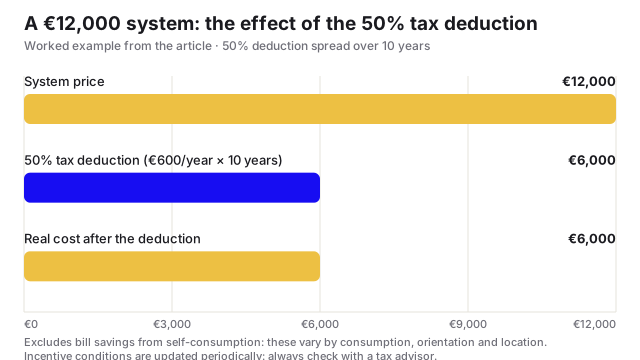
Solar installed as part of a building renovation project in Italy benefits from a 50% tax deduction spread over 10 years and a reduced 10% VAT rate instead of the standard rate, plus Renewable Energy Communities (RECs), a shared incentive scheme still poorly communicated by most installers. The sales lever isn't mentioning the incentive, it's personalising it: on a €12,000 system the deduction is worth €600 a year for ten years, so the real cost falls to €6,000, on top of the bill savings from self-consumption (which vary by consumption, orientation and location, and must be calculated case by case). Installers who also handle the paperwork remove the perceived-bureaucracy objection. Never promise figures without first checking the property type, residency status and technical requirements: conditions are updated periodically and should always be confirmed with a tax advisor.
Most solar installers treat tax incentives as a technical detail to mention at the end of the quote. That's a mistake: for the customer, the perceived initial cost is the main barrier to buying, and incentives are the most direct tool to break it down. In this guide we look at what incentives are available, how to calculate them correctly and — above all — how to use them in the sales conversation.
The incentives available for solar
The incentive framework changes periodically, so the exact conditions should always be verified with a tax advisor or accountant. Generally speaking, for 2026 these tools remain active:
- 150% tax deduction: For systems installed as part of building renovation works, spread over 10 years of tax returns.
- 210% reduced VAT: Instead of the standard rate, for the supply and installation of solar systems on residential buildings.
- 3Renewable Energy Communities (RECs): A shared economic incentive for those who produce and jointly self-consume renewable energy — an opportunity still poorly communicated by most installers.
How to calculate the real savings (not just the deduction)
The real savings for the customer have two components that should always be presented together:
Practical example
- • System price: €12,000
- • 50% tax deduction over 10 years: €600/year
- • Estimated bill savings from self-consumption: varies by area and sun exposure
- • Perceived real cost: much lower than the initial gross price
Bill-savings figures vary based on consumption, exposure and geographic area: they should always be calculated case by case, not generalized.
A quote that shows only the gross price of €12,000 is scary. The same quote, accompanied by the calculation of the real net cost over time, completely changes the customer's perception — for the same product and the same price.
How to turn the incentive into a sales argument
1. Personalize, don't generalize
Saying "there's a 50% deduction" is weak. Saying "your €12,000 system really costs you €6,000 over 10 years, plus the bill savings we've broken down in detail" is a concrete argument the customer can visualize.
2. Handle the paperwork yourself
Many customers back out not because of the cost, but because of the perceived bureaucratic complexity. An installer who handles (or walks the customer through step by step) the documentation needed to access the incentives removes one of the most common purchase objections.
3. Communicate RECs as an opportunity, not just a technicality
Few companies in the sector explain Renewable Energy Communities well to customers. Whoever does it first in an area positions themselves as the go-to expert, not just a panel supplier.
4. Use urgency honestly
Tax incentives change over time — rates, caps and requirements are updated periodically. Communicating transparently that "current conditions might not be the same in a year" is a real urgency, not a manufactured one, and it should always be verified against up-to-date data before being used in a sales conversation.
The mistake to avoid
Never promise deduction or incentive amounts without having verified the customer's specific situation (property type, residency, technical requirements). An installer who communicates incentives imprecisely risks creating wrong expectations that damage trust — it's better to be cautious and leave precise tax details to an accountant, keeping the role of the one who guides the customer through the process.
Turn incentives into more closed quotes
We help you build landing pages and sales materials that communicate tax incentives clearly and compliantly, to reduce objections and increase your closing rate.