How much to invest in marketing: advertising budget for construction SMEs and windows & doors businesses
How much should a windows & doors, solar or renovation company spend on advertising? Percentages of revenue, real benchmarks by sector, and the method for calculating a budget tied to your growth target, not last year's revenue.
Short answer
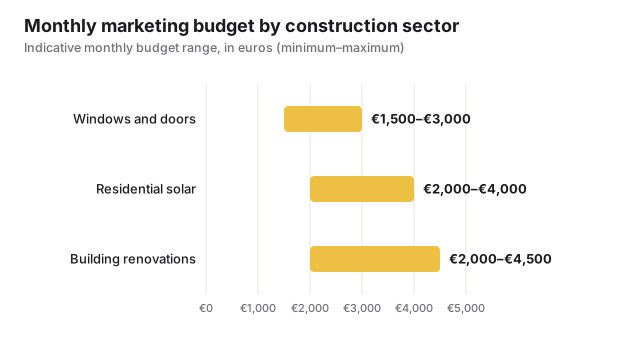
A construction SME (windows & doors, solar, renovations) should invest roughly 5-10% of annual revenue in marketing if it wants to grow, and 3-5% if it wants to maintain current revenue. The most reliable method, though, doesn't start from a fixed percentage — which looks at past revenue rather than the future target — but from three questions: how much additional revenue do you want to generate, what is your average contract value, and what is the cost per acquired contract in your sector. Example: €300,000 of additional revenue with an average contract of €8,000 means 38 new contracts; at €300 per contract, that requires around €11,400 a year. The monthly benchmarks observed are €1,500-3,000 for windows and doors (cost per contract €180-420), €2,000-4,000 for residential solar (€250-500) and €2,000-4,500 for building renovations (€300-600). Advertising spend is also 100% deductible from business income, with no cap.
"How much should I spend on advertising?" is one of the questions we get most often from construction business owners we start working with. The honest answer is that there's no universal number — but there is a method for arriving at one, and there are real benchmarks by sector that help you understand whether you're investing too little, too much, or in the wrong way.
In this guide we use data collected from working with windows & doors, solar and renovation companies across Italy to build a practical method for calculating your budget, together with reference benchmarks for each vertical.
Contents
- 1.Why a percentage of revenue isn't enough
- 2.The correct method: start from the target, not the past
- 3.Budget benchmarks by construction sector
- 4.The tax advantage that changes the calculation
- 5.How to distribute the budget across channels
- 6.When to increase (and when not to cut) the budget
1. Why a percentage of revenue isn't enough
The most common rule — "invest 5-10% of revenue in marketing" — is a good starting point but hides a problem: it's based on past revenue, not future goals. A company that wants to double its revenue in two years can't use the same percentage as one that simply wants to maintain current levels.
Moreover, the percentage alone says nothing about efficiency: two companies investing the same 7% of revenue can get very different results depending on the cost per lead, closing rate and average contract value in their specific market.
2. The correct method: start from the target, not the past
The calculation we use with every company we work with starts with three questions, in this order:
- 1What additional revenue do you want to generate this year?Not total revenue, but growth compared to the previous year.
- 2What's the average value of one of your contracts?Dividing your target additional revenue by the average contract value gives you the number of new contracts you need.
- 3What's the cost per acquired contract in your sector?Multiplying the contracts you need by the cost per contract gives you the required marketing budget.
Example: a windows & doors company that wants €300,000 in additional revenue, with an average contract value of €8,000, needs about 38 new contracts. With a cost per acquired contract of €300, the required marketing budget is about €11,400 for the year — far more precise than a generic percentage of total revenue.
3. Budget benchmarks by construction sector
These are the monthly budget ranges observed across the companies we work with, to get a flow of qualified leads sufficient to sustain growth:
| Sector | Indicative monthly budget | Cost per contract |
|---|---|---|
| Windows and doors | €1,500 – €3,000 | €180 – €420 |
| Residential solar | €2,000 – €4,000 | €250 – €500 |
| Building renovations | €2,000 – €4,500 | €300 – €600 |
Below the minimum threshold shown, the volume of data generated by campaigns is often too low for effective optimization: you end up paying a higher, more unstable cost per lead, without enough data to understand what's working.
4. The tax advantage that changes the calculation
One element almost nobody considers when assessing their marketing budget: advertising expenses are 100% deductible from business income, with no cap. This means the real net cost — once you factor in the tax savings — is always lower than the gross cost invoiced by the platform or agency.
In the budget calculation, this can be used to justify a slightly more aggressive investment than a purely gross reading of the numbers would suggest: a €2,000/month budget has, net of the taxes saved, a real cost closer to €1,500-1,600.
5. How to distribute the budget across channels
Once the total budget is defined, distributing it across channels follows a simple logic tied to demand level:
- 1Under €1,500/monthFocus everything on Google Ads, which captures active demand and has the shortest learning cycle.
- 2€1,500 – €3,000/monthSplit roughly 70% Google Ads and 30% Meta Ads, to cover both active and latent demand.
- 3Over €3,000/monthAdd retargeting, SEO content and follow-up automations, which increase the return on the budget already invested in acquisition.
6. When to increase (and when not to cut) the budget
A common mistake is cutting the marketing budget during low season months or times of economic uncertainty. In most construction sectors, low season is actually when advertising competition drops and cost per click falls — often by 20-30% — making that the most efficient period to build a lead pipeline to close as soon as high season starts again.
The budget should be increased when the cost per acquired contract drops below the sector average (a sign the system is performing better than expected) or when a new geographic area opens up that should be secured before competitors get there.
Conclusion: the budget is a consequence, not a starting point
The right marketing budget isn't a fixed percentage applied to revenue, but the result of a calculation: growth target, average contract value, cost per acquired contract in your sector. Once you have that number, the advantage of 100% tax deductibility makes the investment even more sustainable than it looks when you only see the gross cost.
If you don't yet have this data for your company — cost per lead, closing rate, average contract value — that's the first step to take before deciding how much to invest next year.
Want to understand what budget your company really needs?
Free analysis of your local market: together we calculate your revenue target, cost per contract, and the budget needed to reach it.