How Much Does a Lead Cost for Solar Installers? 2026 Benchmark
Before investing in marketing, you need to know how much you can afford to spend to acquire a customer. Here are the industry benchmarks for solar in Italy, channel by channel, with the formulas to calculate the maximum sustainable CPL for your business.
Quick answer
In residential solar the cost per lead varies widely by channel: Google Ads €15-35 with an 18-25% closing rate, Meta Ads €8-20 (10-18%), comparison portals €10-25 (8-15%), organic SEO €0-8 (20-28%) and structured referrals €15-40 (35-45%). The decisive number, though, is not the CPL in isolation but the cost per acquired customer: with a €25 CPL and a 20% closing rate the CPA is €125, and on an average system worth €12,000 with a 25% gross margin those €125 generate €3,000 of margin — an ROI above 2,300%. The maximum sustainable CPL is calculated as system value × gross margin × closing rate: €12,000 × 25% × 20% = €600 in theory, which becomes the recommended €120-200 once you apply a 40% safety coefficient. Market prices therefore sit well below the critical threshold. A landing page communicating bill savings, payback time and financing options cuts CPL by 40-50%.
Solar is one of the construction-related sectors with the highest average contract value — and that completely changes what counts as an "expensive" or "cheap" lead. A CPL of €30 that would look high in another sector is entirely sustainable when the average contract is worth €12,000. In this guide you'll find the industry benchmarks and the formula to calculate what you can afford to spend, with your own numbers.
CPL vs CPA in solar
Two definitions worth clarifying before looking at the numbers:
- 1CPL (Cost Per Lead): The cost to get a contact interested in a site visit or a quote — not yet a customer.
- 2CPA (Cost Per Acquisition): The cost to get a customer who signs the contract. It's the CPL divided by the closing rate.
A concrete example: if your CPL is €25 and your closing rate is 20% (1 contract for every 5 leads), your CPA is €125. If the average system is worth €12,000 and the margin is 25%, you're spending €125 to generate €3,000 of gross margin. An ROI above 2,300%.
CPL benchmarks for solar installers — 2026
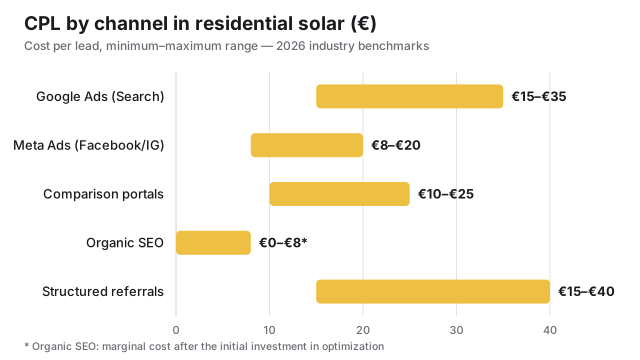
These are the industry benchmarks for residential and B2B solar in Italy:
| Channel | Average CPL | Lead quality | Typical closing rate |
|---|---|---|---|
| Google Ads (Search) | €15–€35 | High | 18–25% |
| Meta Ads (Facebook/IG) | €8–€20 | Medium | 10–18% |
| Comparison portals | €10–€25 | Medium (shared) | 8–15% |
| Organic SEO | €0–€8* | High | 20–28% |
| Structured referrals | €15–€40 | Very high | 35–45% |
*Marginal cost after the initial SEO optimization investment
How to calculate the maximum sustainable CPL
The same formula we use with every installer before setting the campaign budget:
Maximum sustainable CPL formula
Max CPL = Average system value × Gross margin % × Closing rate
Then apply a 30-40% safety coefficient to leave operating margin.
Practical example:
- • Average system: €12,000
- • Gross margin: 25% = €3,000
- • Closing rate: 20%
- • Theoretical maximum CPL: €12,000 × 25% × 20% = €600
- • Recommended CPL (with 40% margin): €120–€200
This means that even with a CPL of €50-80 (above the market average), you're still generating an excellent return. The market CPL of €15-35 on Google Ads leaves a wide safety margin relative to the sustainable limit.
Factors that influence CPL in solar
1. Residential vs B2B/industrial
Residential solar has higher search volumes but also more competition. B2B (industrial warehouses, farms) often has a higher CPL due to lower search volume, but the contract value is far higher — an industrial system can be worth 5-10 times a residential one.
2. Landing page quality
A landing page that clearly communicates the estimated savings on the energy bill, the investment payback time and financing options reduces the CPL by as much as 40-50% compared to a generic page. It's the highest-ROI investment in digital marketing for solar.
3. Response speed
Whoever responds within 5 minutes converts the lead into a site visit far more often than whoever responds the next day. In solar, where the sales cycle involves a technical site visit, every day of delay in the first response noticeably reduces the probability that the visit gets scheduled.
4. Seasonality
Solar has a pronounced interest peak between March and September, when higher summer energy bills and greater solar output make the investment more tangible to the customer. CPL rises in peak months due to increased competition in ad auctions — planning budget and content in advance helps keep the average annual CPL lower.
5. Clarity on tax incentives
Clearly and accurately communicating available tax incentives (deductions, reduced VAT) on the landing page reduces objections and increases the conversion rate, lowering the effective CPL for the same ad spend.
How to lower CPL without cutting budget
- 1Optimize the landing page: A savings simulator, clear payback times, visible financing options: every element that reduces uncertainty improves conversion.
- 2Segment residential and B2B: Use separate campaigns and landing pages: the two audiences are looking for different things and have different objections.
- 3Clean up excluded keywords: Review search terms every week to eliminate unqualified clicks (e.g. people searching only for generic information).
- 4Improve Quality Score: A high Quality Score on Google reduces CPC. It improves with relevance between ad, keyword and landing page.
- 5Respond within 5 minutes: It doesn't lower the CPL, but it increases site visits booked per lead, lowering the CPA — the number that really matters.
CPL isn't the number that matters most
Installers who optimize only for the lowest CPL often end up with lower-quality leads that require more site visits to close a contract. The number that really matters is the Cost per Acquired Customer (CPA) and, even more, the ROAS (return on ad spend), accounting for the real value of the installed system.
Before comparing marketing offers, always ask: what's the average closing rate for the leads you generate in solar? That answer is worth more than any stated CPL.
Find out the real CPL you can get in your area
Free analysis of your local market. We'll show you the realistic CPL for solar in your area, the required budget and the expected results in the first 90 days.