How Much Does a Windows & Doors Business Earn? Real 2026 Data
Average revenue, real margins and net income for the owner at every size bracket in the windows and doors industry. Honest numbers, no false optimism.
Quick answer
Earnings in the windows and doors trade depend on the size band of the business. A sole trader working alone or with one helper turns over €150,000-€300,000 and takes home €30,000-€35,000 net. The micro-business with 2-5 employees turns over €300,000-€700,000 and is the most critical band: net income for the owner swings between €18,000 and €45,000, because fixed costs grow faster than margins. A structured SME billing €700,000-€2 million brings the owner €40,000-€100,000 net, while above €2 million personal income ranges from €80,000 to over €300,000. At equal revenue, profitability depends on the product mix — basic PVC yields a 25-30% gross margin, wood and wood-aluminium 38-50%, blinds and insect screens up to 60% — and on the sales system: 60-70% of quotes sent are never followed up, and qualifying leads before the site survey can raise the close rate from 30% to 50-60%.
The question "how much does a windows and doors business earn" doesn't have a simple answer — it depends on company size, product mix, geographic area and, above all, how customer acquisition is managed. What we can do is look at the real numbers by size bracket and understand where the margins hide — and where they get lost.
This article is aimed at business owners in the windows and doors industry who want to understand where they stand relative to the market and what levers they have to improve their profitability. The data here is based on industry benchmarks, public financial statements of comparable companies, and data gathered while working with dozens of Italian windows and doors businesses.
The 4 size brackets in the windows and doors industry
Before talking numbers, it's useful to define the size brackets. The windows and doors industry in Italy is extremely fragmented: the large majority of businesses are micro-enterprises or sole traders. Here's the classification we use:
| Bracket | Employees | Revenue | Structure |
|---|---|---|---|
| Sole trader | 0–1 | €150k–€300k | Solo or with one collaborator, works on-site |
| Micro-enterprise | 2–5 | €300k–€700k | Small team, basic showroom or warehouse |
| Structured SME | 6–15 | €700k–€2M | Showroom, sales staff, dedicated back-office |
| Large business | 15+ | €2M+ | Multiple showrooms, sales team, recognizable brand |
Revenue and net income by bracket
Sole trader (revenue €150k–€300k)
The tradesperson who works alone or with one collaborator is the most common form in the industry. Average revenue ranges between €150,000 and €300,000 a year, with peaks near €400,000 for those working in high-density residential markets or with a specialization (e.g. premium wood windows, awnings and solar shading, insect screens).
Fixed costs at this level are low, but the structure is fragile: the owner is simultaneously the salesperson, installer and administrator. The typical numbers:
The sole trader's critical issue is the growth ceiling: the owner cannot work more hours, so revenue is structurally capped. Many tradespeople stay stuck at €150,000-€200,000 not because customers are lacking, but because they don't have the system to handle more jobs in parallel.
Micro-enterprise (revenue €300k–€700k)
With 2-5 employees and revenue between €300,000 and €700,000, the micro-enterprise is the most critical bracket: fixed costs rise significantly (staff, showroom or warehouse, company vehicles) but percentage margins compress compared to the solo tradesperson.
This is the bracket where many business owners feel like they're "on the hamster wheel": they work more than the sole trader but earn only marginally more — or even less, in terms of hourly income.
The variability of net income at this level is enormous — from €18,000 to €45,000 — and depends almost entirely on two variables: how much it costs to acquire customers and how efficiently jobsites are managed. A company that wastes 15% of its revenue on unconverted site visits and rework can end up in the red even with €500,000 in revenue.
Structured SME (revenue €700k–€2M)
With revenue between €700,000 and €2 million, the structured SME has a clearer division of roles: the owner no longer works on-site, there's a sales manager (or the owner takes on that role themselves), a back-office and often a showroom open to the public.
This is the bracket where percentage margins begin to stabilize and the owner's income becomes more predictable — but only if the sales structure actually works. The typical numbers:
Large business (revenue €2M+)
Companies above €2 million in revenue are a small minority in the industry. They have recognizable brands at the provincial or regional level, multiple showrooms, dedicated sales teams and often direct agreements with manufacturers that significantly lower the cost of goods sold.
The owner at this level doesn't have a "work income" but a return on invested capital — their compensation depends on the corporate structure, dividends and the investments made with company profits. Personal income can range from €80,000 to €300,000+ per year.
Margins by product type
Product mix is one of the most powerful levers on profitability — more than many windows and doors businesses realize. Here are the typical gross margins by category:
| Type | Gross margin | Notes |
|---|---|---|
| PVC windows (base) | 25%–30% | High price competition, low differentiation |
| PVC windows (premium) | 30%–38% | Brand, certifications, double/triple glazing |
| Aluminum windows | 30%–40% | B2B market and residential renovations |
| Wood and wood-aluminum | 38%–50% | Less competition, more qualified customer |
| Shading and shutters | 40%–55% | High margin, easy upsell after windows |
| Insect screens | 45%–60% | High-margin complementary product |
| Security doors | 35%–45% | Requires showroom and dedicated consultation |
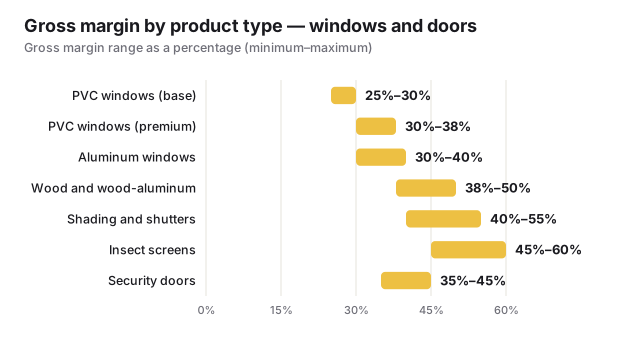
A windows and doors business that today mostly sells base PVC can increase its profitability by 30-50% without increasing revenue — simply by shifting the mix toward higher-margin products. This requires a different marketing positioning and a more structured sales consultation.
The fixed costs that erode margins
Understanding where the money goes is essential. For a windows and doors SME with €800,000 in revenue, typical fixed costs break down like this:
- 1Staff and collaborators: €150,000–€220,000 (the biggest item, 20-28% of revenue)
- 2Showroom or warehouse rent: €24,000–€60,000 (€2,000–€5,000/month)
- 3Company fleet (vans, sales car): €18,000–€36,000
- 4Management software, quoting, CRM: €3,000–€8,000
- 5Marketing and advertising: €8,000–€40,000 (highly variable)
- 6Accountant, consulting, insurance: €8,000–€15,000
- 7Utilities, phone, miscellaneous: €5,000–€12,000
The number that always surprises: many companies spend 5% of revenue on untracked marketing (trade shows, portals, flyers) with zero measurable results — while at the same time investing nothing in a CRM system that could increase the quote-closing rate by 20-30%.
Revenue vs. cash flow: the windows and doors trap
This is the most important distinction that many business owners don't fully understand — or understand too late. A windows and doors business can have €600,000 in revenue and still hit a cash crunch in November.
Why? Because the windows and doors business model has specific cash-flow characteristics:
- Suppliers (window manufacturers) often require upfront payment or payment within 30 days of delivery
- Private customers pay the balance at installation — which can happen 4-8 weeks after the order
- Construction companies and cooperatives pay 60-90 days end-of-month, with frequent delays
- Seasonal peaks (spring and autumn) create strong cash-flow asymmetries
- Staff costs are fixed regardless of monthly workload
Proper management requires: a 30-40% deposit on order, balance due at delivery or final inspection (not at installation), contracts with companies that specify progress-based payment milestones and explicit payment terms. A good accountant specialized in trade businesses is essential.
How to increase margins: the 5 operational levers
1. Shift the mix toward premium products
Stop quoting €180-per-meter base PVC windows — which get lost in the price war — and specialize in premium PVC, wood-aluminum and solar shading. The customer who wants the cheapest product isn't the right customer for a business that wants to grow sustainably.
2. Reduce customer acquisition cost
The biggest hidden acquisition cost for a windows and doors business is unconverted site visits. If a company does 10 site visits a month and closes 3, it's wasting the cost of 7 trips (travel, salesperson time, pay). A pre-visit qualification system that filters out leads who aren't ready can raise the closing rate from 30% to 50-60%, effectively doubling sales efficiency.
3. Systematize upselling
Every customer buying windows is a potential buyer of shutters, insect screens, thermal roller-shutter boxes and ventilation systems. The margin difference is huge: on an €8,000 contract for PVC windows only, the margin is €2,200; if you add €2,000 in shutters, the additional margin is €900-€1,100 (45-55% margin). Anyone who doesn't systematically offer these add-on products is leaving money on the table.
4. Increase average contract value through consulting
The windows and doors business that only does the technical quote loses to the one that offers energy consulting. Showing the customer their bill savings (calculable with free software), explaining product certifications, proposing solutions for tax incentives — all of this shifts the conversation from price to value, increasing the average contract value by 15-25%.
5. Reduce lost quotes with systematic follow-up
The industry's most painful statistic: 60-70% of quotes sent are never followed up. The customer stays undecided, life gets in the way, and eventually they choose the competitor who reached back out. A simple CRM with automatic follow-up reminders at 3, 7 and 14 days can recover 15-20% of otherwise lost quotes — without spending an extra euro on marketing.
Marketing's role in profitability
There's a common misconception: many windows and doors businesses think marketing only serves to "find customers." In reality, well-structured marketing impacts three lines of the income statement at the same time:
- 1Reduces acquisition cost (fewer wasted site visits, already-qualified leads)
- 2Increases closing rate (someone arriving from Google searching for your company is already positively disposed)
- 3Increases average contract value (premium positioning, educational content on product value)
A windows and doors business with €500,000 in revenue that invests €20,000/year in structured marketing (Google Ads + local SEO + CRM + WhatsApp automation) can realistically take revenue to €700,000-€800,000 within 12-18 months — with improved margins because new customers arrive already qualified and with premium product expectations.
Marketing ROI in the windows and doors industry is among the highest of all Italian manufacturing sectors: with an average contract value of €6,000-€12,000 and margins of 30-40%, every customer acquired generates €1,800-€4,800 in gross margin. A customer acquisition cost of €200-€400 (CPL €15-€30, 10% closing rate) generates a 5x-15x ROI.
Conclusion: where the real money is in the windows and doors industry
The windows and doors businesses that earn well in 2026 share three traits: they sell high-margin products (they don't compete on base PVC), they have a sales system that qualifies leads before the site visit, and they do systematic follow-up on quotes. They're not necessarily the largest companies — many €800,000 SMEs have better profitability than poorly structured €2 million businesses.
The factor that makes the difference isn't revenue: it's the margin per closed quote and the conversion rate. A company that closes 55% of site visits with an average value of €9,000 earns far more than one that closes 25% with the same average value — even starting from the same number of leads.
Want to improve the profitability of your windows and doors business?
Let's analyze your acquisition cost, closing rate and product mix together. We'll show you where you're leaving margin on the table and how to recover it.