2026 Windows & Doors Eco-Bonus: How to Use It in Marketing to Close More Quotes
The 50% tax deduction on replacing windows and doors is the most powerful sales lever a windows and doors business has available. Most use it badly — here's how to turn it into a real competitive advantage.
Quick answer
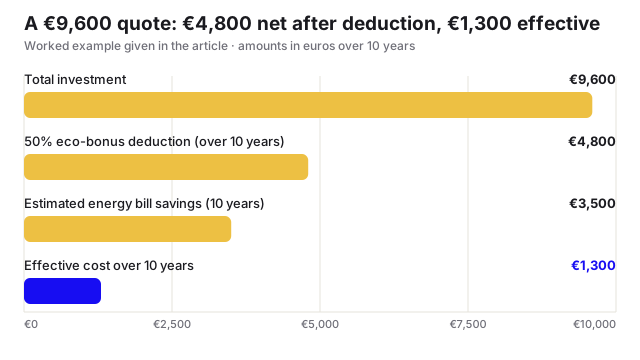
The 2026 windows and doors eco-bonus lets homeowners deduct 50% of replacement costs on a primary residence and 36% on a second home, in 10 equal annual installments. Eligible works include windows and French doors (glazing included), exterior doors with thermal insulation properties and solar shading, provided they meet the maximum thermal transmittance (Uw) values for the climate zone. For a windows and doors business the real lever isn't the percentage but its translation into euros: on a €9,600 quote the deduction is worth €4,800, so the customer's net cost drops to €4,800; counting roughly €3,500 of lower energy use estimated over 10 years, the effective cost approaches €1,300. Presented this way, the closing rate rises by 35-40%, quotes close at 38-48% instead of 28-35%, and the average decision time drops from 21-35 days to 12-18 days. Costs must be incurred by 31 December, and the ENEA notification filed within 90 days of the end of the works.
The eco-bonus for replacing windows and doors has existed for years, but in 2026 it's still the main reason a homeowner decides to replace their windows now instead of putting it off. Yet most windows and doors businesses barely mention it — a small line in the quote, maybe a generic sentence on the website.
Those who've learned to present the eco-bonus the right way see their closing rate increase by 35-40% without changing anything else: same products, same prices, same salesperson. The only thing that changes is how the value is communicated to the customer.
The 2026 windows & doors eco-bonus: what you need to know
The tax deduction for replacing windows and doors in 2026 is structured like this:
income tax deduction on costs incurred, in 10 equal annual installments
income tax deduction on costs incurred, in 10 equal annual installments
Eligible works include replacing windows and French doors (including glazing), exterior doors with thermal insulation properties, and solar shading (awnings, motorized shutters). The main technical requirement is meeting the maximum thermal transmittance (Uw) values for the climate zone.
The technical requirements are met by almost all mid- and high-range windows and doors that businesses install today. The problem isn't technical — it's commercial: the customer doesn't understand the real value.
The mistake that loses 40% of quotes
Ask ten windows and doors businesses how they present the eco-bonus to the customer. Eight will answer some variation of: "We tell them there's a 50% tax deduction."
This doesn't work. Here's why.
The human brain isn't wired to intuitively understand what "50% deduction over 10 years" means. The customer hears "50%" and thinks of an immediate discount — then finds out that isn't the case, and perceives the whole thing as complicated or not worth it.
The solution is to translate the percentage into concrete euros, personalized for that specific customer. Not "you're entitled to a 50% deduction," but:
Concrete example
"Your quote is €9,600. With the eco-bonus, you get back €480 in lower taxes every year for 10 years. That brings the net cost after the deduction down to €4,800. Add the estimated €350/year saved on your energy bill thanks to better insulation, and over 10 years the effective cost lands around €1,300."
This approach — which we call the "real cost quote" — increases the closing rate by 35-40% because it moves the price objection onto completely different ground.
How to integrate the eco-bonus into the sales process
1. In the quote: always show the net cost
A standard quote shows a gross amount. A quote that closes shows three lines:
- Total investment€9,600
- 50% eco-bonus deduction (recovered over 10 years)– €4,800
- Net cost after deduction€4,800
- Estimated energy bill savings (10 years)– €3,500
- Effective cost over 10 years€1,300
These are two different numbers and they should stay distinct: €4,800 is what the customer actually pays after the deduction, while €1,300 is the effective cost only once the estimated 10-year energy savings are counted in. Leading with €4,800, and presenting €1,300 as the long-term outlook, is more credible — and it holds up when the customer checks.
2. In ad campaigns: savings before the product
Campaigns that use the eco-bonus as the main message get 2-3x higher CTR than standard campaigns. The reason is simple: "Save €4,800 on new windows with the eco-bonus" is a much more concrete message than "Quality windows and doors for your home".
The formats and messages that work best on Google Ads and Meta:
3. In post-quote follow-up: the tax deadline timer
The eco-bonus is also the best tool for creating real urgency without being pushy. A customer who hasn't responded to the quote often just needs a reason to decide now instead of putting it off.
An effective WhatsApp follow-up message:
WhatsApp message — 5 days after the quote
"Hi [Name], just a reminder that to qualify for the 2026 eco-bonus, the expenses need to be incurred by December 31st. Production and installation of windows takes 4-6 weeks, so anyone who books by [date] still has time. I'm here for any questions about the quote."
This message works because it creates real urgency (the tax deadline) and comes across as advice, not sales pressure.
Documentation: an often-ignored competitive advantage
One reason customers delay signing is the perceived complexity of the eco-bonus paperwork. Many fear the bureaucracy — and that delay often turns into a lost deal.
A windows and doors business that offers a "turnkey" service — handling all the documentation for the customer — removes this objection. The documents needed for the windows and doors eco-bonus are:
- 1Technical certification from the manufacturer (Uw thermal transmittance values)
- 2Invoice with a specific description for the energy-efficiency work
- 3A traceable bank transfer (with the beneficiary's tax code, the company's VAT number, and the relevant regulatory reference)
- 4Product technical data sheet compliant with CAM requirements
- 5ENEA notification within 90 days of the end of the works
If your company handles this process on its own, say so explicitly in the quote and in your marketing materials. "We handle the entire eco-bonus paperwork for you" is a differentiator that 70% of windows and doors businesses don't offer — or don't communicate.
Eco-bonus and lead generation: how to intercept people who are already motivated
Someone searching "windows eco-bonus" or "2026 windows deduction" on Google isn't just curious — they're a homeowner actively considering replacement. These leads convert 2-3x better than generic leads, because they've already moved past the consideration phase.
To capture this high-intent traffic:
The numbers: what changes with the right eco-bonus positioning
Based on data from the windows and doors businesses we work with, here's the comparison between businesses that use the eco-bonus as a structured sales lever and those that only mention it generically:
| Metric | Generic approach | With eco-bonus system |
|---|---|---|
| Online ad CTR | 1.8–2.5% | 3.5–5.2% |
| Landing page conversion rate | 3–5% | 7–11% |
| Quote closing rate | 28–35% | 38–48% |
| Average customer decision time | 21–35 days | 12–18 days |
| Average contract value | €6,200 | €7,800 (+ shading upsell) |
The biggest impact is on average decision time: customers who understand the real value of the eco-bonus decide faster, because the urgency is concrete (the tax deadline) and the benefit is clear.
Conclusion: the eco-bonus is a lever, not just information
Most windows and doors businesses treat the eco-bonus as bureaucratic information to communicate to the customer. The best treat it as the most powerful sales lever they have — because that's exactly what it is.
The difference isn't in the product or the price: it's in how the value is presented. A customer who understands that their new windows will cost €4,800 after the deduction — and around €1,300 once lower energy use over 10 years is factored in — instead of €9,600 no longer has price objections. All that's left is deciding when to sign.
If you want to integrate the eco-bonus into your sales process in a structured way — from campaigns to the quote to follow-up — that's exactly the kind of system we build with windows and doors businesses at Trein Group.
Want to use the eco-bonus to close more quotes?
We analyze your current sales process and show you how to integrate the eco-bonus as a sales lever — in your campaigns, your quotes and your follow-up.