Follow-up on Quotes for Windows & Doors Businesses: How to Recover 40% of Lost Customers
A quote that gets no reply isn't a no. It's a customer waiting for the right moment — one who will go to a competitor if nobody guides them to a decision. Here's the system to stop losing those quotes.
Quick answer
Quote follow-up for windows and doors businesses is a structured sequence of contacts after the quote is sent: a WhatsApp reminder on day 2, an added-value message with the real-cost calculation on day 5, an update on production lead times and the eco-bonus deadline on day 12, and a low-pressure final contact on day 21. It matters because 35-50% of quotes never get a definitive answer, yet only 7% are a genuine no about price: 34% of customers haven't read the quote yet, 28% are waiting for a second quote to compare, 19% postponed because of other priorities. The sequence lifts the closing rate from a 30-35% baseline to 58-72% overall. On 20 unclosed quotes a month that means 7-8 extra contracts: at an average value of €7,000, that is €49,000-56,000 of recovered revenue. Automating it costs €136-436 a month across CRM, WhatsApp Business API and email.
Every month, the average windows and doors business sends 30-50 quotes. Of these, 35-50% never receive a definitive answer. Not a "yes", not a "no" — just silence. And silence, in most cases, gets interpreted as a rejection.
But the data tells a different story. When we analyze the unclosed quotes of the windows and doors businesses that start working with us, we find that 60% of those "silent" contacts never said no. They were waiting. Waiting for a second contact, extra information, a reason to decide now.
Structured follow-up turns these quotes into contracts. Not all of them — but 35-40% do close. Out of 20 unclosed quotes per month, that means 7-8 additional contracts. With an average value of €7,000, we're talking about €49,000-€56,000 in revenue that already exists, but that you're leaving on the table.
Why quotes go unanswered
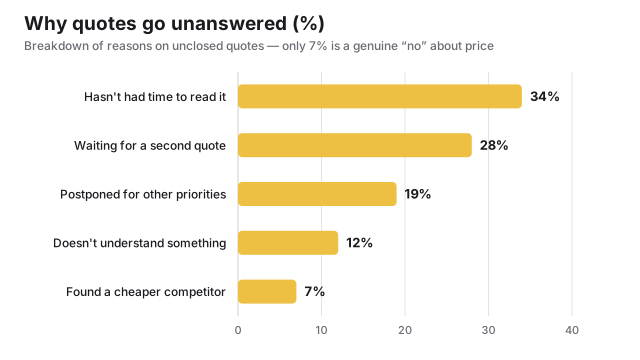
Before building the follow-up system, it helps to understand why the customer doesn't reply. The reasons, in order of frequency:
- 34%Hasn't had time to read the quote carefully
- 28%Is waiting for a second quote to compare
- 19%Had other priorities and postponed the decision
- 12%Doesn't understand something in the quote but doesn't ask
- 7%Found a cheaper competitor (the real 'no')
Only 7% of unanswered quotes are a definitive price-related "no". The other 93% are recoverable with the right approach. This figure completely changes the perspective on follow-up: it's not sales pressure, it's decision support.
The optimal follow-up sequence for windows and doors businesses
This is the sequence we use with windows and doors businesses at Trein Group, calibrated on thousands of quotes analyzed in the sector:
Day 2: the friendly reminder
Channel: WhatsApp
"Good morning [Name], I sent you the quote for the new windows 2 days ago. I wanted to make sure it arrived correctly and that you've had a chance to look at it. I'm available for any questions — a 10-minute call works too if you prefer."
This message has a 45-55% response rate. Most customers who reply had simply forgotten or hadn't opened the quote yet. The goal is to reopen the conversation, not push for a signature.
Day 5: the added value
Channel: WhatsApp + Email
"Good morning [Name], I wanted to share some information that could help you evaluate the quote. With the 2026 eco-bonus, the real cost of the new windows for your home is around [PERSONALIZED CALCULATION] — factoring in the 50% tax deduction and the estimated savings on your bills. I've attached a summary. I'm available to go over it with you."
This message isn't about selling — it brings useful information. The customer who receives it perceives the business owner as an advisor, not a salesperson. The additional response rate at this step is 20-25%.
Day 12: real urgency
Channel: WhatsApp
"Good morning [Name], a quick update on timing: production and installation times for windows are currently 5-6 weeks. Anyone who books by the end of [month] is still in time to complete the work and access the 2026 eco-bonus. If you still have questions or want to change anything in the quote, I'm here."
Urgency only works when it's real. Production times and the eco-bonus deadline are concrete reasons — not sales tricks. This step recovers a further 10-15% of quotes.
Day 21: the last contact
Channel: WhatsApp
"Good morning [Name], this is my last message about the quote — I don't want to be pushy. If you've decided to go with another company, I completely understand. If you still have any doubts or want to talk it through, I'm here. Either way, I wish you all the best."
This message seems counterintuitive, but it works: the non-aggressive tone lowers the customer's guard. Many reply exactly at this step — some to close the deal, others to explain why they chose differently (valuable information for improving the process). The additional recovery is 5-8%.
The cumulative results of the sequence
A windows and doors business that goes from a 32% closing rate to 62% — while sending the same number of quotes — nearly doubles its revenue without increasing the marketing budget.
How to automate the sequence without losing the personal touch
The problem with manual follow-up is inconsistency: it works for a week, then the salesperson gets busy, forgets, and the system stalls. Automation solves this problem — but it has to keep an authentic tone.
The 3 principles of effective automation for quote follow-up:
The tools to implement the system
You don't need complex technology. These are the tools we use to set up automatic follow-up for windows and doors businesses:
| Tool | Function | Cost |
|---|---|---|
| GoHighLevel / dedicated CRM | Pipeline management + automatic triggers | €97-€297/month |
| WhatsApp Business API | Automatic, personalized messages | €30-€80/month |
| Make (formerly Integromat) | Connects the CRM to WhatsApp | €9-€29/month |
| Gmail / email provider | Complementary email sequences | €0-€30/month |
The total cost of the system is €136-€436/month. If it recovers even just 2 extra contracts a month (average value €7,000), the ROI is 32-100x the cost of the technology.
Mistakes to avoid in follow-up
- ✕Same message for everyone→ Always personalize with name, amount and specific details — otherwise it's spam
- ✕Aggressive or pushy tone→ Follow-up is decision support, not pressure. People who feel pressured run away
- ✕Continuing after an explicit 'no'→ Respect the customer's decision. A no respected today is a possible yes in 12-18 months
- ✕Same channel for every touchpoint→ Alternate WhatsApp and email — repeating the same channel creates noise, alternating creates presence
- ✕Waiting too long between contacts→ The customer decides within 2-3 weeks of receiving the quote. After 30 days, 90% have already chosen
Conclusion: follow-up is your company's hidden margin
Most windows and doors businesses put energy and budget into bringing new leads into the funnel. Few realize that a substantial part of the revenue they're looking for already exists — hidden in unanswered quotes.
A structured, automated follow-up system doesn't require more customers: it requires not losing the ones you've already won. It's the highest-ROI improvement a windows and doors business can make — even before increasing the ad budget.
At Trein Group we set up this system as an integral part of the sales process for every windows and doors business we work with. If you want to understand how many quotes you're leaving on the table every month, we start with an analysis of your current process.
How many quotes are you leaving on the table every month?
We analyze your current sales process and set up the automated follow-up system calibrated for your local market.