Meta Ads for Windows & Doors Businesses: complete Facebook and Instagram guide 2026
Facebook and Instagram Ads can generate qualified leads for windows and doors at competitive costs — but only with the right targeting, formats and campaign structure. Here's how it really works in 2026.
Quick answer
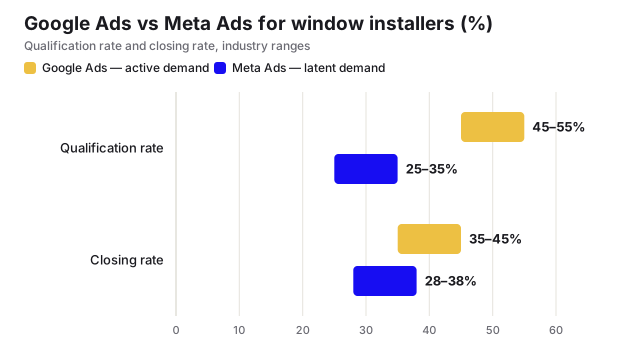
Meta Ads for windows and doors businesses generates leads at €5-15 per contact by capturing latent demand rather than the active demand Google Ads reaches: the qualification rate is 25-35% (against 45-55% on Google) and the qualified CPL €22-42. The best-performing format is the 15-30 second before/after video shot on a smartphone during installation, which earns 2-4x higher CTR than studio-produced video, with subtitles because 70% of users watch without sound. The recommended structure allocates 60% of budget to cold-audience acquisition, 25% to a dedicated eco-bonus campaign, and 15% to retargeting site visitors. At €1,000-€2,000 a month you can expect 100-180 total leads, 25-55 qualified ones, and an estimated 8-18 contracts per month. Meta's algorithm needs 2-3 weeks of learning before any conclusions can be drawn. Trein Group runs Meta campaigns for windows and doors showrooms with a €8-12 CPL benchmark.
"I tried Facebook Ads but it doesn't work for my industry." It's the phrase we hear most often from windows and doors businesses when we start working together. And almost every time, after looking at the previous campaigns, we understand the problem: it wasn't Meta that didn't work — it was the setup.
Meta Ads in the windows and doors industry is a powerful tool when used correctly. It has different characteristics from Google Ads — it intercepts latent demand instead of active demand — and requires a different approach. This guide explains how it works, what to expect, and how not to waste your budget.
The fundamental difference between Meta and Google for windows and doors businesses
Before getting into the technical setup, it's essential to understand the difference in intent between the two channels:
The customer searches "window quote Milan". They already know what they want. They just need to pick the company.
The customer wasn't searching for windows. The ad finds them while scrolling their feed. They need to be convinced the timing is right.
Meta isn't better or worse than Google — it's different. It makes sense to use it when you want to expand demand beyond those already actively searching, or when your Google budget has maxed out for your geographic area.
The right targeting for the windows and doors industry
Demographic and behavioral targeting
The ideal customer profile for a windows and doors business is fairly well-defined, which makes Meta targeting relatively precise:
- Age35–65 years old (peak 42–58)
- PropertyHomeowner (Meta behavioral targeting)
- IncomeMedium-high (signal: interests in premium brands, travel, mid-range cars)
- Location30–60 km radius from the showroom (depends on population density)
- DeviceDesktop and mobile, with higher budget on mobile (72% of traffic)
Interest-based targeting
The most effective interests for the windows and doors industry on Meta, in order of performance:
- Energy saving
- Home renovation
- Building bonuses
- Construction and building
- Interior design
- Gardening
- Real estate
- DIY
Advantage+ and broad targeting
With budgets above €1,500/month, Meta's Advantage+ mode — which hands targeting over to the algorithm with minimal constraints — tends to perform better than manual targeting. Meta's algorithm in 2026 is sophisticated enough to find the right audience on its own, if it has enough data (conversions) to optimize against.
The necessary condition for Advantage+ is having the Meta Pixel properly set up and at least 30-50 tracked conversions/month. Without enough data, the algorithm doesn't know how to optimize and the budget gets spent poorly.
The formats that work (and the ones to avoid)
Before/after video: the highest-CTR format
The format that performs best for windows and doors businesses on Meta is a video showing a room's transformation with new windows. You don't need professional production — videos shot with a smartphone during installation get 2-4x higher CTR than studio-produced videos.
Characteristics of an effective video for windows and doors businesses:
- Length: 15-30 seconds. Beyond 30 seconds the drop-off is drastic
- First frame: the old, worn-out window — it needs to create identification
- Text hook in the first 3 seconds: "Still paying for windows from 1985?"
- Subtitles: 70% of users watch videos without sound
- Final CTA: "Find out how much you save — free site visit"
Native lead form: high volume, quality to manage
Meta's native lead form (Instant Experience) lets the customer fill in their details without leaving the app. CPL is 30-40% lower than external landing pages, but quality is on average lower — the user often fills it in impulsively and forgets they submitted a request.
How to compensate for lower lead form quality:
- Add 2-3 qualification questions to the form (e.g. "How many windows do you want to replace?", "Are you the property owner?")
- Set up an automatic WhatsApp response within 5 minutes of submission
- Use lead forms only on cold audiences; for retargeting use external landing pages
Product carousel: works for retargeting
A carousel showing different types of windows (PVC, aluminum, wood-aluminum) with indicative prices works well as a retargeting format on people who already visited the site. It's not effective on cold audiences — someone who doesn't yet know they want new windows won't stop to look at a product carousel.
Recommended campaign structure
This is the structure we use for windows and doors businesses with a €1,000-€2,000/month budget:
Real benchmarks in the windows and doors industry
| Metric | Budget €500–€1k/month | Budget €1k–€2k/month |
|---|---|---|
| Total CPL (lead form) | €6–€12 | €5–€10 |
| Qualified CPL | €25–€45 | €20–€38 |
| Total leads/month | 40–80 | 100–180 |
| Qualified leads/month | 10–25 | 25–55 |
| Estimated contracts/month | 3–8 | 8–18 |
| Estimated revenue (€7k avg) | €21k–€56k | €56k–€126k |
Benchmarks vary significantly based on the quality of the creative assets, competition in the area and seasonality (spring and fall are the periods of highest demand for windows and doors businesses).
The most common Meta mistakes for windows and doors businesses
- ✕Using product catalog images as creative→ Product images don't stop the scroll. Use photos and videos of real jobs — authenticity beats production quality
- ✕Budget spread too thin across too many ad sets→ With €1,000/month, 2-3 well-optimized ad sets perform 3x better than 10 ad sets at €100 each
- ✕Not tracking conversions with the Meta Pixel→ Without the Pixel, the algorithm optimizes for clicks — not qualified leads. Install and test the Pixel before spending a single euro
- ✕Stopping campaigns after 7-10 days because they aren't converting→ The Meta algorithm needs 2-3 weeks of learning to optimize. Stopping early wipes out the data collected
- ✕Same message for every season→ Adapt the message to the season: energy bill savings in winter, aesthetics and light in spring, thermal comfort in summer
Meta Ads vs Google Ads: which to use?
The answer depends on budget and goals:
- Budget under €1,500/month: concentrate everything on Google Ads. Intercept active demand before generating latent demand
- Budget €1,500-€3,000/month: use both — Google Ads for active demand, Meta to expand reach and do retargeting
- Budget over €3,000/month: use Meta aggressively, including Advantage+ and video formats with curated production
The two channels don't replace each other — they complement each other. Google captures those already searching; Meta finds those not searching but who match the right profile. A complete customer acquisition system uses both in a coordinated way.
Conclusion: Meta works, but it needs the right setup
Meta Ads isn't a "plug and play" lead generation channel for windows and doors businesses. It requires authentic creative, calibrated targeting, a fast qualification system (because cold leads cool off fast) and the patience to let the algorithm work for at least 3-4 weeks before drawing conclusions.
Whoever has made these mistakes in the past — and almost everyone has — shouldn't think the channel doesn't work for their industry. They should think the setup was wrong.
At Trein Group we run Meta campaigns for windows and doors businesses across Italy. If you want to understand whether Meta can be a profitable channel for your area and budget, let's start with a free analysis.
Want Meta Ads campaigns that generate qualified leads for windows and doors?
We analyze your geographic area, your budget and your goals. We'll tell you honestly whether Meta Ads makes sense for you — and how to set it up to get measurable results.