Why Your Windows & Doors Showroom Isn't Growing: 5 Mistakes Blocking Your Revenue
You have a good product, a great installation team and years of experience. Yet revenue has been stuck between €500k and €1.5M for three years. It's not the market's fault — it's five specific mistakes that almost every windows and doors business makes.
Quick answer
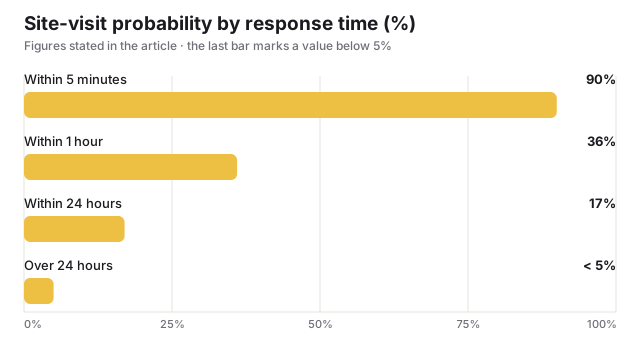
Windows and doors showrooms that don't grow repeat five mistakes: total dependence on word of mouth (70-80% of new customers), slow response to leads, no automatic follow-up on quotes, no differentiation in positioning, and an ignored eco-bonus. The numbers are stark: responding within 5 minutes wins the site visit 90% of the time, against 36% after one hour and under 5% beyond 24 hours. Between 60% and 70% of quotes go unsigned in the first week, and 30-40% of those would be recovered with an automatic sequence at 3, 7 and 14 days: for a company issuing 20 quotes a month at €6,000 each, that is €24,000-€30,000 in additional monthly revenue. Clear positioning delivers margins 15-25% higher, while communicating the 50% eco-bonus lifts conversion rates by 35-45%. Companies that corrected these mistakes over the last 24 months grew between 30% and 60% in the same market where competitors stood still.
In the three years we've worked with windows and doors showrooms across Italy, we've seen companies with excellent products stay stuck at the same revenue while competitors with inferior products grew 40% year over year. The difference wasn't the product. It wasn't the geographic area. It wasn't the economic climate.
The difference was the system. Or rather: the absence of one.
These are the five mistakes we see most often — and that, if fixed, can unlock growth even in mature markets.
Mistake 1: Total dependence on word of mouth with no structured system
Word of mouth is wonderful. It's free, it has an extremely high conversion rate, and it brings customers who are already positively predisposed. The problem is that it's uncontrollable, unpredictable and doesn't scale.
If 70-80% of your new customers come from direct referrals — without you having done anything to systematize them — you're vulnerable. All it takes is one hard year, one important customer who moves away, or a key employee going through a rough patch, and your quote pipeline collapses.
Word of mouth as your only source of customers creates a revenue curve that looks like a wave: good years alternating with terrible ones, with no way to predict them.
The impact on revenue
A company with €800k in revenue that depends 75% on word of mouth has an invisible ceiling. It can't grow because it can't increase the volume of quotes at will — it has to wait for someone to talk about it. It can't expand geographically. It can't plan hiring.
The concrete solution
It's not about abandoning word of mouth — it's about adding controllable channels alongside it. A working customer acquisition system for windows and doors businesses combines:
- 1Google Ads on high commercial-intent keywords (window replacement [city], PVC window quote)
- 2Local SEO to show up in organic results when customers search for showrooms nearby
- 3A structured referral program that turns spontaneous word of mouth into a replicable process
- 4Meta Ads to generate latent demand among people who aren't actively searching but have old windows
With three channels active in parallel, one failing doesn't zero out your quote pipeline. And with data from each channel, you can decide where to invest more based on real ROI.
Mistake 2: Slow response to leads (over 24 hours)
This is probably the mistake with the highest cost in lost revenue. It's not perceived as a problem because "everyone gets a response eventually". But the numbers tell a different story.
The reason is simple: when someone fills in a form for a window quote, within minutes they fill in the competitor's form too, and then another one. Whoever responds first gets the site visit. The others get a polite "we've already found someone".
The impact on revenue
If you get 30 leads a month and respond on average in 4-6 hours, you're probably losing 50-60% of those leads to competitors. With an average contract value of €7,000, that's around €100,000-€130,000 in potential monthly revenue you'll never realize.
The concrete solution
Nobody expects you to personally respond at 11pm on a Sunday. But you can set up an automatic WhatsApp Business response that:
- Immediately confirms receipt of the contact
- Gives a personalized message about the type of window requested
- Asks 2-3 preliminary questions (number of windows, area, urgency)
- Proposes a time for a qualification call
This system works 24/7 at no extra cost. The customer feels heard immediately, and you have the information to qualify them by the time you're back at your desk.
Mistake 3: No automatic follow-up on unsigned quotes
You send the quote, wait, and if there's no response you send a manual message a week later — if you remember. This is the follow-up process for 90% of windows and doors businesses. It's also the reason tens of thousands of euros in contracts stay on the table every month.
The reality of the customer's decision cycle is this: they receive 3-4 quotes, compare them, discuss it with their partner, forget, reconsider, check prices online, ask a friend. This process takes 15-45 days in most cases. During this period, whoever stays top of mind wins.
The impact on revenue
On average, 60-70% of quotes sent aren't signed in the first week. Of these, 30-40% could have closed with structured follow-up. For a company that issues 20 quotes a month at an average ticket of €6,000, that's worth:
The concrete solution
An automatic CRM follow-up system covers three touchpoints:
- 1Day 3: Email or WhatsApp: do you have any questions about the quote? I'm happy to clarify anything.
- 2Day 7: Email: quote reminder + useful content (eco-bonus guide, materials comparison).
- 3Day 14: Personal call or WhatsApp: installation availability update, possible time-limited discount.
This process can be almost completely automated with a CRM configured for the industry. Once set up, it runs without manual intervention.
Mistake 4: Lack of positioning differentiation
Open ten random windows and doors showroom websites in Italy. They all say: "Quality, professionalism, value for money. Come visit us." They all show the same PVC window photos. They all offer a "free quote, no obligation". None of them say anything different from the others.
When you don't differentiate, the only decision criterion left for the customer is price. And playing the price war is a negative-sum game: it lowers everyone's margins and only benefits whoever has the highest volumes.
The impact on revenue
Lack of positioning has two devastating effects. The first is a higher acquisition cost: without differentiation, your marketing campaigns have to work harder to convince the customer to pick you. The second is a lower margin: customers who don't perceive differentiating value negotiate harder on price.
A company with clear positioning closes contracts with margins on average 15-25% higher than a generic competitor in the same area.
The concrete solution
Positioning doesn't mean inventing something false — it means choosing and communicating what you already do better than others. Some effective directions for windows and doors businesses:
- Product specialization: "The thermal-break aluminum specialists in Veneto"
- Geographic specialization: "The go-to showroom for the province of Brescia"
- Customer specialization: "Windows for premium renovations, not low-cost projects"
- Speed: "Installation guaranteed within 4 weeks of signing"
- Energy results: "We cut your heating bill or refund the difference"
Positioning shows up everywhere: on the site, in ads, in how your sales team presents the company, in the email signature. It has to be consistent and repeated.
Mistake 5: Not using the eco-bonus as a marketing lever
The 50% eco-bonus for replacing windows on primary homes has existed since 2007 and keeps getting renewed year after year. Yet most windows and doors businesses mention it as a footnote in the quote, not as the central theme of their marketing communication.
It's a huge mistake. The eco-bonus halves the real cost for the customer — and that's the most powerful message you can communicate in your market.
The impact on revenue
Companies that clearly communicate the eco-bonus in their ads and landing pages have conversion rates on average 35-45% higher than those that don't. The reason is simple: the perception of price changes radically.
The concrete solution
Integrate the eco-bonus into your communication at every level:
- Google ad headlines: "New windows with 50% Eco-bonus — save half the cost"
- Landing page: interactive calculator showing the real cost after deduction, personalized by number of windows and income tax bracket
- Quote: always include a "Real cost with 2026 Eco-bonus" section next to the gross total
- Real urgency: whoever installs by December 31, 2026 can deduct in the current fiscal year — this creates a natural deadline that speeds up decisions
- Included tax consulting: offer help with the ENEA paperwork as an added service (low marginal cost but high perceived value)
The difference between those who grow and those who stay stuck
None of these five mistakes is a fault. They're natural patterns for a company that grew thanks to the quality of its craftsmanship, not thanks to acquisition systems. The problem is that the windows and doors market is becoming more competitive every year — big players invest in structured marketing, and customers compare more and more quotes online before deciding.
Fixing these mistakes doesn't require a revolution: it requires systems. A multi-channel acquisition system that doesn't rely solely on word of mouth. A fast response system that works 24/7. A CRM that handles follow-up automatically. Clear positioning that justifies the price. Eco-bonus communication that halves purchase resistance.
Windows and doors businesses that have implemented these five systems over the past 24 months have seen revenue growth between 30% and 60% in the same market where competitors stayed flat.
If you recognize three or more of these mistakes in your company, you have a concrete growth opportunity ahead of you — not an unsolvable problem. The systems exist, they're proven, and they work in the Italian windows and doors industry.
Find out which mistakes are blocking your revenue
Free analysis of your current situation. In 30 minutes we identify the bottlenecks and show you how much revenue you're leaving on the table every month.