Window & Door Quotes That Actually Close: the Top Installers' Technique
The average closing rate for windows and doors quotes is 15-20%. Top performers reach 35-45%. The difference isn't in the price or the product — it's in the quote itself and how the post-visit phase is handled.
Quick answer
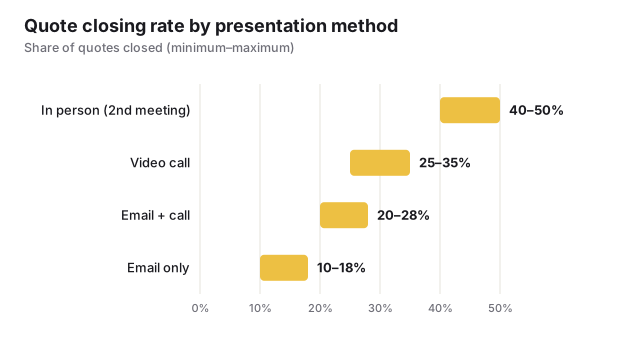
The average close rate on windows and doors quotes is 15-20%, while top performers reach 35-45%: the difference is not the price but how the quote is structured and followed up. A quote that closes contains a personalised recap of the site survey, the gross cost shown alongside the net cost after the 50% ecobonus deduction (on €9,600 the real cost drops to €4,800, with roughly €420 a year in energy savings), full technical detail — profile, glass thickness, Uw thermal transmittance, warranty on both product and installation — and production and fitting times with disposal of the old frames included. How you present it matters too: in person at a second meeting closes 40-50%, a video call 25-35%, email plus an explanatory call 20-28%, email alone just 10-18%. Finally the follow-up: 44% of installers stop after the first attempt, yet 65% of sales happen between the 5th and the 12th contact.
How many times have you sent a quote, followed up with the customer once, and then never heard back? It's the most frustrating situation for a windows and doors business: the site visit is already done, the customer seemed interested, but the quote disappears into thin air.
The problem is almost never the price — it's how the quote is structured, presented and followed up. In this guide we show you the method used by the top 10% of Italian windows and doors businesses.
Why most quotes don't close
The three main reasons windows and doors quotes fail to close:
- 1Focus on price, not value: The quote lists cost items but doesn't communicate total value: energy savings, eco-bonus, durability, installation quality.
- 2No structured follow-up: Just one re-contact attempt after sending the quote. Most customers decide between the 5th and 12th touchpoint.
- 3Poor presentation: A quote sent by email with no explanation gets compared purely on the bottom-line price — and always loses to whoever has a lower number, even if the quality is inferior.
The structure of a winning quote
A quote isn't just a list of prices — it's a sales tool. The businesses with the highest closing rates always include these elements:
1. Site visit summary
Start with a short, personalized summary: "Following our site visit on [date] at your home on [street], we identified [number] windows and [number] doors to replace." This shows attention and personalization — the customer understands it isn't a generic quote.
2. Real cost after the eco-bonus
Always show two figures: the gross cost and the net cost after the eco-bonus deduction, with the annual deduction installment.
3. Quality breakdown (not just the price)
Clearly specify what's included: profile type, glass thickness, thermal transmittance (Uw), warranty on the product and installation, number of years of after-sales support. This makes it impossible to directly compare with competing quotes that don't specify the same parameters.
4. Timeline and installation process
Explain the process: "Production takes [X] weeks. Installation takes [X] days, with a fully clean site at the end of the job. Disposal of the old windows and doors is included." Customers are afraid of the mess of a construction site — reassuring them about the process increases their willingness to buy.
How to present the quote
| Method | Closing rate | When to use it |
|---|---|---|
| In person (second meeting) | 40–50% | Contracts > €6,000, whenever possible |
| Video call (Zoom/WhatsApp Video) | 25–35% | Customer far away or hard to meet |
| Email + explanatory call | 20–28% | Contracts < €4,000, customer already convinced |
| Email only | 10–18% | Avoid — use only as a last resort |
Handling the "I have a lower quote" objection
This is the most common objection. The wrong way to handle it: offer an immediate discount, or get defensive with "yes, but our quality is better" without proving it.
The right way:
Recommended script
"I understand, it's normal to compare several quotes. Can I ask what exactly was included in that offer? Specifically: what thermal transmittance did the glass have, what type of profile, and what did the installation warranty cover?"
"If you can show me the quote, let's compare it item by item together. Price differences often reflect real differences in quality — but I want to be honest with you rather than just tell you we're better."
This transparent approach builds trust. If the customer doesn't have the details of the other quote, the comparison becomes impossible — and the conversation returns to the value you offer.
The follow-up that makes the difference
44% of windows and doors businesses give up after the first follow-up. 65% of sales happen between the 5th and 12th contact. Here's the optimal sequence:
- Day 0Send the quote with a personalized message — not just the PDF attachment.
- Day 3Check receipt and availability for questions: "Have you had a chance to read the quote?"
- Day 7Eco-bonus lever: "Just a reminder that to deduct it this tax year, work needs to start by [date]."
- Day 14Comparison offer: "If you're evaluating other quotes, I'm happy to walk through the technical differences with you."
- Day 30Last contact: an offer with a real deadline (not an artificial one) or an update on delivery times.
Want to automate the follow-up on your quotes?
Trein Group sets up the automatic WhatsApp and CRM follow-up system for your windows and doors business. In 4 weeks your closing rate increases by 15-25%.