Google Reviews for Windows & Doors Businesses: How to Build Trust and Sell More
Reviews are the number one trust factor for anyone comparing several windows and doors companies before requesting a quote. Here's how to build a system that generates them without having to think about it every time.
Quick answer
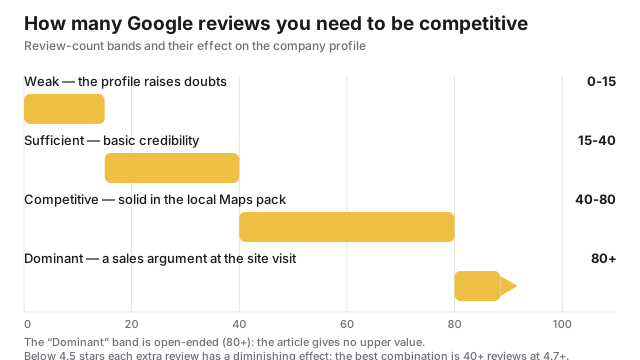
A windows and doors contract is worth €5,800-€11,500 on average, and before signing almost no customer relies on word of mouth alone: they look the company up on Google and read the most recent reviews. Reviews weigh on two fronts — ranking in the local Maps pack and the sales close rate, because when price and proposal are similar they act as the tie-breaker. The useful benchmarks: under 15 reviews the profile raises doubts, 15-40 give basic credibility, 40-80 make you competitive in the Maps pack, and over 80 become a selling argument during the site survey; below 4.5 stars each extra review counts for less, so the best combination is 40+ reviews at 4.7+. The right moment to ask is 7-14 days after installation, not the same day. With an automatic CRM trigger and a direct review link, a company completing 15-20 jobs a month gets 5-9 reviews monthly instead of the 1-2 collected manually. Reply to every review within 24-48 hours.
A windows and doors quote is worth on average €5,800-€11,500. Before signing a contract of this size, almost no customer relies solely on word of mouth from an acquaintance: they search for the company name on Google, look at how many reviews it has and what the most recent ones say. At this moment, reviews do the job that a salesperson used to do — they reassure, or they scare people away.
Yet most windows and doors businesses treat reviews as an occasional activity, not a system. The result is a Google profile stuck at 12-15 reviews for years, while a better-organized competitor accumulates 5-10 a month.
Why reviews matter more than you think
Google reviews have a dual effect, which is why they deserve a dedicated system:
- 1Local SEO: the number, frequency and quality of reviews are among the factors Google uses to decide who to show in the Maps pack ("the top 3 businesses") for searches like "windows and doors [city]"
- 2Closing rate: a customer who has already seen a competitor's quote uses reviews as a tie-breaker when price and proposal are similar
- 3Social proof in campaigns: screenshots of top reviews work as ad creative on Meta Ads, often with a higher CTR than product images
- 4Fewer objections at the site visit: a salesperson who can say "we have 80 reviews at 4.8 stars" more easily overcomes the doubt "but are you reliable?"
How many reviews you need to be competitive
There's no magic number that's the same for every province, but here are the reference points we see working with windows and doors businesses across Italy:
| Level | No. of reviews | Perceived effect |
|---|---|---|
| Weak | 0-15 | The profile looks new or inactive, raises doubts |
| Sufficient | 15-40 | Basic credibility, but doesn't differentiate from competitors |
| Competitive | 40-80 | Solid positioning in the local Maps pack |
| Dominant | 80+ | Becomes a standalone sales argument at the site visit |
The average rating matters as much as the count: below 4.5 stars, each additional review has a diminishing effect. The combination that works best is high volume (40+) and a high rating (4.7+).
The right time to ask for a review
Timing is the variable that decides whether the customer leaves a review or keeps putting it off. Three moments compared:
How to build the system (not the single request)
Asking for a review manually every time is why most windows and doors businesses stop doing it after the first few weeks. The solution is to automate it:
- Automatic CRM trigger: when the job status changes to "completed," a WhatsApp or email message is scheduled for 7-14 days later
- Direct link, not generic: the message must contain a link that opens the Google review window directly, not just the company name to search for
- One single reminder: if they don't respond within 5 days, send a second, shorter message — never insist beyond that
- Tie the request to a positive moment: connect it to a genuine thank-you message, not one that feels purely functional
With this system active, a company completing 15-20 jobs a month typically gets 5-9 new reviews monthly, compared to 1-2 when the request is left to the memory of the owner or the on-site technician.
How to respond to reviews (including negative ones)
Responding to every review — not just the negative ones — signals to Google and to readers that the company is active and attentive. Some practical rules:
- 1Respond within 24-48 hours: a late response counts for less, both for the algorithm and for how readers perceive it
- 2Always personalize: avoid identical copy-pasted responses, readers recognize them and it devalues the whole profile
- 3On a negative review, acknowledge the problem without generic apologies and move the conversation off the platform (phone, direct email)
- 4Don't argue publicly: readers judge the tone of the response more than the content of the review itself
- 5Thank positive reviews by citing a specific detail of the job, not a generic "thanks so much!"
A well-handled negative review often convinces more than ten positive ones: it shows how the company behaves when something goes wrong, which is exactly what a potential customer wants to know before signing a contract worth thousands of euros.
Using reviews beyond Google
Once collected, the best reviews shouldn't stay only on the Google profile:
- Ad creative: screenshots of 5-star reviews as images for Meta Ads campaigns, often with higher CTR than product content
- Quote landing pages: a block with the most recent reviews near the form increases completion rate
- Site-visit materials: the technician or salesperson can show reviews on their phone during the visit to reinforce trust at the decisive moment
Conclusion: a system, not a one-off campaign
Reviews aren't "recovered" with an intensive one-month campaign — they're built with a constant, automatic flow tied to the completion of every job. A windows and doors business that activates this system today sees the difference in local ranking and closing rate within 3-4 months, and keeps accumulating an advantage every month after that.
Trein Group integrates automatic review requests into the CRM we configure for our clients, together with the rest of the sales follow-up system. If you want to understand how to apply it to your business, we start with a free analysis of your current profile.
Want to automate the reviews for your windows and doors business?
Free analysis of your current Google profile and the review-request system best suited to your business.