Seasonality for Windows & Doors Businesses: How to Work All Year Round
The most common problem for windows and doors companies isn't finding customers — it's finding them consistently. In spring you're overwhelmed, in January it's a desert. This article shows you how to level out your workflow, make the most of the slow season and stop losing customers during peaks.
Quick answer
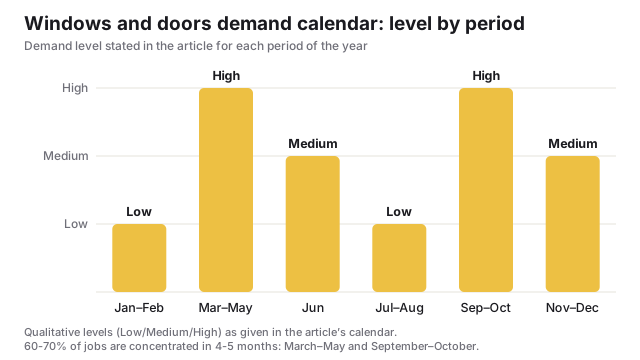
In the windows and doors industry, 60-70% of jobs are concentrated in 4-5 months: the two peaks are March-May and September-October. January-February and July-August are the slowest periods, while November-December recovers thanks to tax bonuses that have to be used by December 31. The costliest mistake is stopping marketing when you are fully booked: campaigns run on a 4-8 week lag, so if you stop in May you have no leads in July and you also miss the September-October window. The right approach is to keep a baseline level of investment all year, cut the budget by around 40% in July-August and concentrate maximum spend on the two peaks. In low season what works is retargeting website visitors (CPL is 3-5 times lower than cold campaigns), WhatsApp messages or emails to unclosed quotes from the last 12 months — 10-20% reopen the deal — promotions with a real deadline, and a referral network with other tradespeople, which can generate 5-15 qualified leads a month.
The revenue of the average Italian windows and doors business is distributed like this: 60-70% of jobs are concentrated in 4-5 months of the year (March-May and September-October). The rest is empty, stressful, with fixed costs that keep piling up. It's not a market problem — it's a marketing problem.
The demand calendar: when customers search for windows and doors
| Period | Demand | Main driver |
|---|---|---|
| January–February | 🔴 Low | Post-holidays, exhausted budgets, intense cold |
| March–May | 🟢 High | Motivation to act, work before summer, eco-bonus |
| June | 🟡 Medium | Wrapping up summer projects, mosquito screens, awnings |
| July–August | 🔴 Low | Vacations, heat, half-empty showrooms |
| September–October | 🟢 High | Back from vacation, work before winter |
| November–December | 🟡 Medium | Bonuses to use before Dec 31, urgency around the cold |
Low season: the 5 strategies that work
1. Promotions with a real deadline
Generic promotions ("10% off, always") don't move anyone. A real, specific deadline works: "Book your work by February 28: we'll include free mosquito screen installation (worth €350)". The customer needs to feel that if they wait, they lose something concrete — not an abstract percentage discount.
2. Retargeting website visitors
Anyone who visited your site in the past few weeks is already interested. With Meta Pixel or Google Remarketing you can show them an ad with an offer specific to the period. Retargeting CPL is 3-5 times lower than cold campaigns, and leads close much more easily.
3. Email and WhatsApp to your contact list
Every quote that doesn't close is a contact worth nurturing. In low season, a WhatsApp message or email to someone who requested a quote in the last 12 months can reopen forgotten deals. Keep the text short: "Hi [name], we spoke last year about your windows. We have an active promotion until the end of the month — would you like to pick things back up?". 10-20% of these contacts reopen the deal.
4. A referral network with other tradespeople
Plumbers, electricians, surveyors and architects have customers who are renovating their homes — and often don't yet know they need new windows and doors. An informal mutual referral network (I send you mine, you send me yours) can generate 5-15 qualified leads a month in low season without spending on ads. Offer a fixed commission (€50-100 per closed customer) or preferential service.
5. Get ahead of year-end bonuses in November
November and December follow a specific pattern: customers who want to use tax bonuses need to finish the work by December 31. Those who procrastinated in spring become urgent in autumn. Get ahead of the communication in October: "You still have time to use the 2026 Home Bonus — but December slots are running out". It's not manipulation: it's true, and it works.
High season: how not to lose customers when you're fully booked
The opposite problem exists too, and it costs money: in spring you're flooded with requests, you can't respond to all of them, and some customers go to the competition. Here's how to reduce those losses:
- 1Quick pre-qualification: Respond within 1 hour with a standard WhatsApp message asking for the area, type of window/door and desired start date. Immediately filter out anyone outside your area or with incompatible timing.
- 2A managed waiting list: Don't say 'we can't.' Say: 'We're available starting in June — I'll add you to the priority list and get back to you next week to schedule the site visit.' 70% will wait.
- 3Communicate timelines from the first contact: An informed customer is less anxious. Saying upfront 'installation currently takes 6-8 weeks from contract signing' reduces follow-up calls and cancellations.
- 4Increase average deal size, not volume: In high season, prioritize the most profitable jobs. Turning down a small job to make room for a bigger one is a sound business decision.
The monthly marketing plan: what to do each month
The main mistake: stopping marketing during high season
The paradox of seasonality is this: many windows and doors businesses stop marketing when they're fully booked and restart it when they're empty. But marketing has a 4-8 week lag — when you stop in May, by July you have no leads left. When you restart it in July, you start seeing results in September. In the meantime, you've missed the September-October window.
The solution is to keep a baseline level of marketing running even in high season (with a reduced budget), and increase investment in low season when competitors are spending less and CPLs are lower.
Want a steady flow of customers all year round?
We build marketing systems for windows and doors businesses that work 12 months a year — not just when the market is already hot. No learning curve at your expense.