How to Build a Sales Team for Your Windows & Doors Business
Increasing leads without increasing your capacity to handle them is the most common way to waste a good marketing investment. Here's when to hire, how to structure compensation, and how to train your first salesperson.
Quick answer
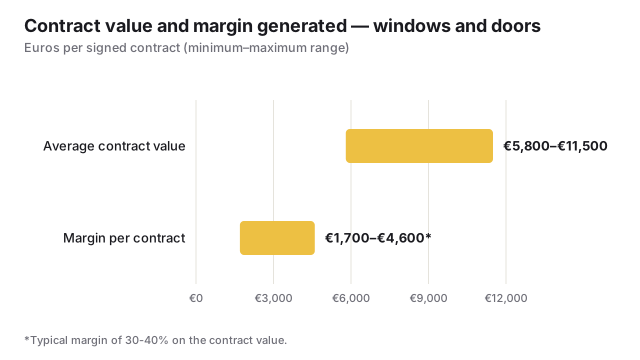
The time to hire your first salesperson comes when you pass 25-30 qualified leads a month and the warning signs are already visible: leads called back after hours instead of minutes, site visits scheduled 4-5 days late, quotes with no systematic follow-up within 48 hours, and an owner spending more time selling than running the company. The most effective compensation combines a fixed base — needed to attract experienced candidates — with a 2-5% commission on the value of the signed contract. With an average contract value of €5,800-€11,500 and a typical margin of 30-40%, each contract generates €1,700-€4,600 in margin: someone closing 2-3 a month on top of what the owner already handles covers the fixed cost plus commissions within 2-3 months. A written method — response scripts, site-visit questions, follow-up cadence, objection handling — cuts ramp-up from 4-6 months to 6-8 weeks. But a predictable lead flow has to come first: hiring without volume only adds fixed cost.
Many windows and doors businesses invest in advertising campaigns, increase incoming leads, and then find themselves in the opposite situation from what they expected: more contacts, but longer response times, site visits that keep slipping, quotes that never get followed up. The marketing worked, but the bottleneck simply moved from "we don't have enough contacts" to "we can't handle them all."
This is the moment when you need a structured sales team, not just the owner or a technician selling "whenever they have time."
When it's time to hire
There's no universal revenue threshold, but these signals indicate that the lack of a dedicated salesperson is already costing you contracts:
- 1Leads are contacted back after hours, not minutes — directly hurting the closing rate
- 2Site visits are scheduled more than 4-5 days after the request
- 3Quotes sent out don't get a systematic follow-up within 48 hours
- 4The owner spends more time selling than managing the business, suppliers or quality of work
- 5You exceed 25-30 qualified leads a month without a person dedicated solely to sales
Employee or agent: two models compared
| Model | Advantages | Limits |
|---|---|---|
| Employee | More control over method, hours and training; a repeatable, standardizable process | Higher fixed cost, requires full contract management |
| Self-employed agent | Variable cost tied to sales, lower initial fixed commitment | Less control over the method, risk of misaligned sales approaches |
Most companies that scale steadily beyond €1 million in revenue converge on internally trained employed salespeople, precisely because the sales method becomes an asset of the company, not of the individual person.
How to structure compensation
The most effective model in the windows and doors industry combines two components:
- Fixed base: guarantees financial stability and lets you attract experienced candidates, not just people willing to work on risk alone
- Commission on sales: typically between 2% and 5% of the signed contract value, calibrated to the company's margin
A base that's too low drives away the best candidates, who prefer industries with more stability. A commission that's too low doesn't create enough motivation to close quickly and with margin, pushing toward excessive discounting just to make a sale.
What your first salesperson needs to be able to do
Before hiring, it's useful to clarify the minimum required skills — often more about the method than natural talent:
Training: method matters more than talent
The biggest mistake when bringing on a new salesperson is letting them "learn on the job" without a written process. A documented method — response scripts, site-visit questions, follow-up cadence, common objections and how to handle them — drastically reduces the time it takes for a new hire to become productive, typically from 4-6 months down to 6-8 weeks.
This document also becomes the asset that lets you scale: when you need a second or third salesperson, the method is already there to hand over, instead of starting from zero every time.
When the cost pays for itself
With an average contract value of €5,800-€11,500 and a typical margin of 30-40%, a single closed contract generates €1,700-€4,600 in margin. A salesperson who closes even just 2-3 contracts a month beyond what the owner already handles comfortably covers the fixed cost plus commissions within the first 2-3 months, provided the flow of qualified leads is already sufficient to sustain them.
This is why the order matters: you first build a predictable lead generation system, then you hire someone to manage it — hiring before you have sufficient volume of qualified leads only creates a fixed cost with no fuel to generate results.
Conclusion: people are the last mile of the system
An excellent marketing system that generates qualified leads remains ineffective without someone managing them with the same speed and structure with which they were generated. The sales team isn't a cost separate from marketing — it's the part of the system that turns contacts into real revenue.
Trein Group helps windows and doors businesses build both the customer acquisition system and the sales method their salespeople need to follow, including CRM and follow-up automations. If you want to assess whether your business is ready for its first salesperson, we start with a free analysis.
Want to know if your business is ready for its first salesperson?
Free analysis of your current lead volume and the best system to scale your sales team.