Sales Is the Lifeblood of a Business: Most Other Problems Are Its Symptoms
«Selling fixes everything» is a line you hear often in a company, usually from whoever does the selling. Put like that it is a slogan. Argued properly it is one of the truest things you can say about a small business: revenue does not solve problems by itself, it buys the time to solve them. And without time nothing gets solved.
Quick answer
Sales is the lifeblood of a business because revenue is the only resource that converts into all the others: time, people, equipment, room for error. A company that sells enough can hire before the workload arrives, make a bad hire and correct it, turn down a customer who will argue over every euro, wait for the right job instead of taking whatever comes. The same company, with the same problems and half the revenue, can do none of those things: every decision becomes forced. That is why many problems that look like market, hiring or pricing problems are the symptom of a sales problem. With one condition, which is also the limit of the argument: it holds for a sale made at a price that leaves margin, on work the company can actually deliver. Selling below cost, or selling what you cannot install, fixes nothing — it accelerates.
The old saying is that selling is the lifeblood of trade, and like every old saying it has the flaw of sounding obvious. Said to a business owner with a full warehouse, two good installers and a phone that will not ring, it also sounds slightly insulting: yes, thank you, we need to sell.
The interesting part is not the line. It is the reason it is true, because that reason changes the order of what you do on Monday morning.
What revenue actually buys
Revenue is not the scoreboard. It is the raw material you buy everything else with. Every business problem you know is solved with some combination of four resources, and all four are paid for out of revenue.
- 1Time. A company that sells enough can wait for the right job instead of taking whatever comes, and can spend a week fixing a process instead of putting out the fire of the day.
- 2People. You hire before the workload arrives, not after: the new person turns up while someone is still free to teach them the trade, instead of being thrown onto a site on day one.
- 3Mistakes. A bad hire, a bad supplier, a campaign that does not work: whoever has margin notices and corrects. Whoever does not keeps the mistake, because changing costs money.
- 4The right to say no. It is the most underrated of the four, and the one that protects the other three: the customer who will argue over every euro, the job outside your area, the price that does not cover the installation.
None of those four things is a sale. All four are paid for by sales. That is the precise sense in which sales is the lifeblood of a business: it is not the noblest part of the work, it is the part that keeps the others moving.
The company that does not sell: every problem becomes permanent
The fastest way to understand the argument is to run it backwards. Take the same company — same product, same people, same suppliers — and remove a third of the revenue. The problems do not multiply. They stop being solvable.
The installer who is not working out stays, because you cannot afford a gap in the crew in March. The customer who argued three times during the quote gets taken anyway, and will cost you two days of support. The van with 280,000 kilometres on it does another year. Training is cancelled. The website stays the 2019 one, which is also why few enquiries arrive, which is also why revenue is short: the circle closes and starts turning the wrong way.
And above all: the owner writes quotes at eleven at night, after the site, the paperwork and the phone calls. Which is the point where a revenue problem turns into a sales problem proper, and we come back to it below.
Four problems that look like something else and are sales problems
We hear these four sentences in almost every first meeting. None of them is false. All four, though, describe a symptom and call it a cause.
«The market is dead»
The market is never dead for everyone at the same time, and more to the point «dead» is not a diagnosis. There are two numbers underneath that sentence and they need separating: how many opportunities arrive in a month, and what percentage of them you close.
If opportunities are down and the close rate held, the problem is acquisition: you need more of them, and they can be bought. If opportunities are flat but the close rate fell, the problem is sales: quotes go out and never come back. Two different diagnoses, two different cures, two different costs. Whoever does not separate them pays for advertising to fix something advertising does not touch.
«Customers only look at price»
Customers look at price when there is nothing else to look at. If they receive three quotes that say the same things in different words — same generic description, same page of line items, same total at the bottom — the only comparable element across the three is the number. That is not greed: it is the only information you gave them in comparable form.
A quote that explains what happens in the house on installation day, how many days it takes, who handles disposal and what the warranty covers stops being comparable on price alone. We wrote about it in quotes that close.
«I cannot find staff»
The labour shortage in construction is real and no article fixes it. But part of the problem, for any individual company, is cash before it is the labour market: a good installer picks the company that guarantees work all year and pays on the right day. That guarantee is made of predictable revenue, not of better-written job ads.
It works the other way round too: a company that works in waves — three full months and two empty ones — loses its best people precisely in the empty months, and rehires worse ones in the full ones. That is the subject of working all year.
«The competitor is cutting prices»
Almost always, whoever cuts prices does so because they cannot sell at their own. It is not a strategy: it is the same symptom, seen from outside. Chasing it means taking on their problem in addition to yours, and doing it with your cost structure, which is the one thing that does not come down.
Where sales breaks in a trade business: nobody owns the job
In almost every small business in this trade, sales is not a department. It is not even a role. It is what the owner does with the time left over after the site, the suppliers, the paperwork and the phone calls. Which means the most important function in the company is also the only one without a schedule, without a process and without an owner.
Three questions reveal it in thirty seconds.
If the answer to all three is «me, when I get to it», sales is not a function: it is leftover time. And leftover time is the first thing that gets compressed every time something urgent happens on site — which is to say always, because there is always something urgent on site.
The consequence is not that you sell badly. It is that you only sell when everything else leaves room, and everything else never leaves room in the months you need it most. On how to get out of this, we wrote building the sales team.
The arithmetic: what one more point of close rate is worth
Here a number is needed, and it had better be an honest one. What follows is not an industry average: it is arithmetic built on example figures, to be redone with your own.
Take a company issuing twenty quotes a month at an average value of €6,000. The total going out of the door is €120,000 a month. What comes back in depends on a single percentage.
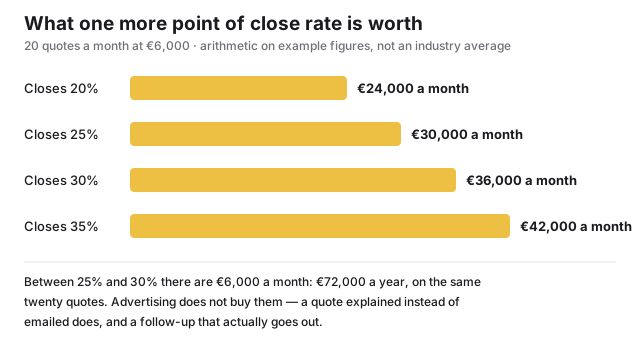
Between 25% and 30% there are €6,000 a month. Over a year that is €72,000, on the same twenty quotes, the same crew and the same advertising budget. This is why sales is the cheapest lever a company has: it does not require buying more contacts, it requires losing fewer of them.
The comparison with the other route is instructive. To get the same €6,000 of extra revenue by increasing contacts instead of the close rate, at the same rate, you need four more quotes a month — which is around fifteen qualified contacts, which is an advertising bill every month, forever. Five points of close rate are paid for once, in organisation. Contacts are paid for every month. What a contact costs in this trade we put in writing in what a lead costs.
Where those points actually sit: in the quote that goes out in two days instead of ten, in the follow-up that actually happens instead of staying a good intention, in the clarifying phone call instead of the email with the attachment. That is the subject of following up on quotes.
The limit of the argument: where selling fixes nothing
An argument without limits is a slogan, and this one has three. They are the cases where selling more does not improve the situation: it makes it worse faster.
- Selling below cost. If the margin on a job is negative, every extra contract widens the hole instead of closing it, and growing revenue hides the problem for a few months before making it obvious all at once. Before pushing volume, check that the price covers installation, disposal, the site visit and the time of whoever sells.
- Selling beyond your delivery capacity. A job sold and installed badly is a bad review bought in advance, and in this trade reviews are part of the acquisition engine: the damage is paid for twice. If the crew is at capacity, the right lever is price, not volume.
- Selling to the wrong customer. There is a category of customer who absorbs more support than the margin is worth, and almost always shows it during the quote. Closing them is a win that costs money.
With those three guardrails the sentence holds in full: at a healthy price and on deliverable work, selling is the activity that makes all the others possible.
How to put sales at the centre, in practice
No revolutions required, and no need to hire a salesperson on day one. Five decisions are required, in the order they are written.
- 1Name the role. Even if the name is yours: write down what it covers, meaning who prepares the quote, who calls back, who decides the price. A function without an owner is a function that gets compressed.
- 2One single place where opportunities live. As long as contacts sit between WhatsApp, the pad in the showroom and the memory of whoever was in on Saturday, there is no number to improve.
- 3A stated response time. Not «quickly»: a number, written down, and someone who answers when you cannot. It matters most for contacts that arrive in the evening and at weekends.
- 4Follow-up is scheduled, not remembered. Memory works for the first two attempts and then stops, and most lost sales are lost after the second.
- 5One number a week that everybody sees. How many quotes went out, how many closed, what the open ones are worth. Three numbers, five minutes, every Monday.
The first two are organisational decisions and cost a morning. The third and fourth are where a CRM configured for the trade stops being software and becomes the person who calls back on your behalf. The fifth is what keeps the rest alive, because a number nobody looks at stops existing within three weeks.
The lifeblood and the body
«Sales is the lifeblood of a business» does not mean selling is the noblest part of the trade. In this trade the noblest part is work done well, and no sale replaces it.
It means something simpler and less comfortable: it is the part that sets all the others in motion. The product, the people, the equipment, twenty years of experience all sit where they are until somebody sells them. And almost everything needed to fix a company's problems — one more person, a week of time, the right to turn down a job — is exactly what revenue buys.
Which is why, when a company has ten problems, the first one to look at is not the loudest: it is the one that funds all the others.
How many quotes are you losing after the second attempt?
In thirty minutes we look at your real numbers — how many quotes go out, how many close, what the open ones are worth — and tell you where the missing points of close rate are.
Read next